
Automatic vs Manual Driving: Which One Should You Learn First?
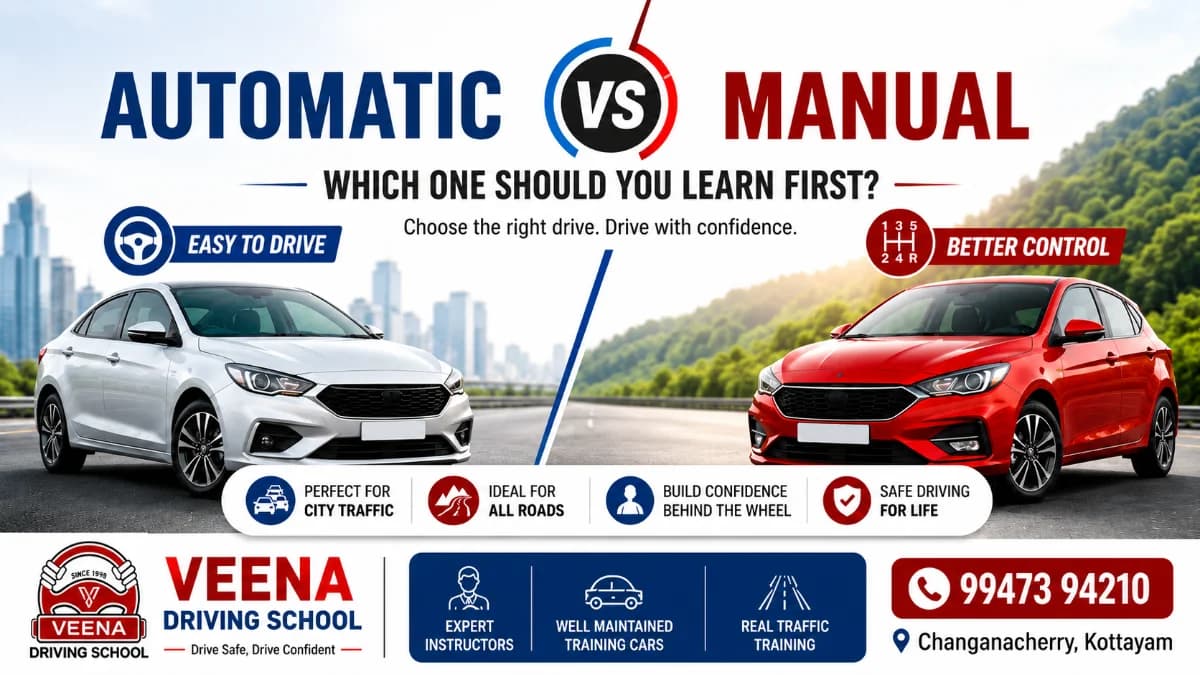
Automatic vs Manual Driving: Which One Should You Learn First?
Learning to drive is one of the most valuable life skills, offering freedom, convenience, and confidence. However, before you even sit behind the wheel, one important question arises: Should you learn to drive a manual car or an automatic car? With automatic vehicles becoming increasingly popular in India while manual cars continue to dominate the roads, many first-time learners find themselves confused about which option is the better choice.
The truth is that both transmission types have their own advantages, and the right choice depends on your driving goals, lifestyle, confidence level, and future plans. If you're planning to drive only within the city, an automatic car may be ideal. On the other hand, if you want maximum flexibility and the ability to drive almost any vehicle, learning manual driving first can be a valuable investment.
In this guide, we'll explain the key differences between manual and automatic cars, compare their advantages and disadvantages, answer frequently asked questions, and help you decide which type of driving lessons are best for you.
Understanding the Difference Between Manual and Automatic Cars
Before deciding which type of driving lessons to take, it's important to understand how each transmission works.
A manual transmission requires the driver to operate three pedals: the accelerator, brake, and clutch. The driver must manually shift gears using the gear lever depending on the vehicle's speed and road conditions. This means the driver has complete control over gear selection and engine performance.
An automatic transmission, on the other hand, removes the need for manual gear changes. The vehicle automatically shifts gears based on speed and acceleration, leaving the driver with only two pedals—the accelerator and brake. Without the need to operate a clutch, driving becomes much simpler and more comfortable, especially in heavy traffic.
Why Choosing the Right Transmission Matters
Many beginners assume that learning to drive is the same regardless of the type of vehicle. While the basic rules of the road remain unchanged, the learning experience differs significantly between manual and automatic cars.
Your choice will influence how quickly you learn, how confident you feel during lessons, the types of vehicles you can drive in the future, and even your career opportunities if you plan to become a professional driver.
Making an informed decision before starting your driving lessons can save both time and money while ensuring that your training matches your long-term driving goals.
Is Manual Driving Difficult?
One of the most common questions beginners ask is whether manual driving is difficult. The answer is not really—but it does require practice and coordination.
Unlike an automatic car, a manual vehicle requires you to control the clutch while simultaneously balancing the accelerator and changing gears at the right time. During the first few lessons, many learners experience engine stalling, jerky starts, or difficulty coordinating the clutch and accelerator. These challenges are completely normal and are part of the learning process.
As you continue practicing under the guidance of a qualified driving instructor, your muscle memory develops naturally. Eventually, changing gears and controlling the clutch become second nature, allowing you to focus more on the road rather than the vehicle controls.
The difficulty lies not in manual driving itself, but in learning the coordination required during the initial stages.
Why Many Beginners Prefer Automatic Cars
Automatic vehicles have become increasingly popular because they simplify the driving experience. Since there is no clutch pedal and no need to manually change gears, beginners can concentrate entirely on steering, braking, maintaining lane discipline, and observing traffic.
This reduced workload makes automatic cars particularly suitable for first-time learners, senior citizens, people with driving anxiety, and individuals who frequently drive in congested city traffic.
For someone who feels nervous behind the wheel, eliminating the complexity of clutch control often helps build confidence much faster.
Which Is Better for Beginners?
For most first-time learners, automatic driving lessons offer a smoother introduction to driving. Because there are fewer controls to manage, learners usually gain confidence more quickly and experience less stress during training.
However, learning manual driving provides a stronger technical foundation. It teaches better vehicle control, improves coordination, and enables you to drive both manual and automatic vehicles in the future.
If your goal is simply to drive your own automatic car comfortably, automatic lessons may be sufficient. If you want the flexibility to drive almost any passenger vehicle, learning manual first is generally the better option.
Can You Drive an Automatic Car After Learning Manual?
Absolutely. In fact, this is one of the biggest advantages of learning manual driving first.
Once you've mastered clutch control, gear changes, and vehicle balance in a manual car, transitioning to an automatic vehicle becomes extremely easy. Since automatic cars remove the need for clutch operation and manual gear shifting, most manual drivers adapt within a very short time.
This is why many driving instructors recommend learning manual first if you're comfortable taking on a slightly greater learning challenge.
Can You Drive a Manual Car After Learning Automatic?
The reverse isn't quite as simple.
If you've only learned to drive an automatic vehicle, you'll still need separate training to learn clutch control, gear shifting, hill starts, and manual vehicle handling before driving a manual car safely.
Although the road rules remain the same, manual driving requires additional coordination that isn't taught during automatic driving lessons.
Advantages of Learning Manual Driving
Learning manual driving offers several long-term benefits beyond simply operating a vehicle.
Perhaps the greatest advantage is flexibility. Manual drivers can comfortably operate both manual and automatic cars, making them more adaptable when borrowing vehicles, renting cars, or driving company vehicles.
Manual driving also provides greater control over the vehicle. Drivers can select gears according to road conditions, making it easier to manage steep hills, overtaking, or driving on challenging terrain.
Additionally, manual transmissions are often mechanically simpler, which may result in lower maintenance costs over the long term. For individuals considering careers in commercial driving, logistics, transport, or heavy vehicle operation, manual driving remains an important and valuable skill.
Advantages of Learning Automatic Driving
Automatic driving focuses on simplicity and convenience.
Without constantly operating the clutch or changing gears, drivers experience significantly less fatigue, particularly in heavy traffic. This makes automatic vehicles an excellent choice for urban commuting where frequent stopping and starting are common.
Automatic cars are also particularly beneficial for older adults, people recovering from injuries, or anyone who wants a relaxed driving experience.
Because learners spend less time worrying about vehicle controls, they often become confident road users much sooner.
Which Is Better for Kerala Roads?
Kerala presents unique driving conditions.
Drivers regularly encounter narrow roads, sharp curves, busy town centers, steep hills, frequent traffic signals, and unpredictable traffic patterns.
In cities and towns such as Changanacherry and Kottayam, automatic cars provide greater comfort during daily commuting because they eliminate repeated clutch operation in stop-and-go traffic.
However, manual cars remain extremely common throughout Kerala. Learning manual driving therefore provides greater flexibility and ensures you're comfortable driving a wider variety of vehicles whenever required.
Fuel Efficiency: Is Manual Still Better?
Many people still believe manual cars always offer better fuel economy.
While this was largely true several years ago, modern automatic transmissions have improved dramatically. Today's automatic vehicles are designed to optimize gear changes efficiently, making the difference in fuel economy much smaller than it once was.
In reality, fuel efficiency depends more on driving habits, regular maintenance, traffic conditions, and engine technology than simply the type of transmission.
Maintenance Costs
Manual transmissions are generally simpler in design, containing fewer mechanical components. This often results in lower repair costs if maintenance is required.
Automatic transmissions are more complex and may involve higher servicing expenses depending on the vehicle model.
However, modern automatic vehicles are extremely reliable when maintained according to the manufacturer's recommendations, making long-term ownership both practical and dependable.
Driving in Heavy Traffic
Traffic is one of the biggest reasons many drivers choose automatic vehicles.
In a manual car, frequent stopping requires constant clutch operation and repeated gear changes. Over time, this can become tiring, especially during long commutes.
Automatic cars remove this burden completely. Drivers only need to operate the accelerator and brake, making city driving smoother, more comfortable, and less stressful.
Parking and Low-Speed Driving
Parking is another area where beginners often struggle.
Reverse parking, parallel parking, and maneuvering through tight spaces require careful vehicle control.
Automatic cars make these tasks easier because there is no clutch to balance while steering. Learners can focus entirely on positioning the vehicle accurately without worrying about stalling the engine.
This is one reason many new drivers quickly gain confidence in automatic vehicles.
Hill Driving
Driving on steep slopes can be intimidating for beginners.
Manual cars require proper clutch control during hill starts to prevent the vehicle from rolling backward. This takes practice and coordination.
Many modern automatic vehicles include features such as Hill Hold Assist, which prevents rollback and makes hill driving much easier.
Nevertheless, learning proper hill-start techniques in a manual vehicle helps develop excellent overall driving skills.
Professional Driving and Career Opportunities
If you're considering a career in commercial driving, manual driving remains highly valuable.
Many logistics companies, transport operators, fleet owners, and commercial vehicle employers continue to use manual transmission vehicles.
Learning manual driving also provides an excellent foundation for progressing to Heavy Motor Vehicle (HMV) and trailer driving courses.
Having manual driving skills broadens your career opportunities and increases your versatility as a professional driver.
Common Misconceptions About Automatic and Manual Cars
There are several myths surrounding both transmission types.
Some people believe automatic cars are only for beginners, but many experienced drivers prefer them because they reduce fatigue and provide a more comfortable driving experience.
Others assume manual cars are always superior. While manual driving offers greater control and flexibility, it isn't necessarily the best choice for everyone.
Another common misconception is that automatic cars consume much more fuel. Advances in transmission technology have significantly reduced this gap, making many modern automatic vehicles almost as efficient as their manual counterparts.
Finally, many beginners fear that manual driving is impossible to learn. In reality, thousands of people successfully master manual driving every year through proper instruction and consistent practice.
How to Choose the Right Driving School
Regardless of whether you choose manual or automatic driving lessons, selecting the right driving school is crucial.
A quality driving school should focus not only on helping students pass the driving test but also on developing safe, responsible, and confident drivers.
Look for experienced instructors who provide patient guidance, practical road training, parking practice, highway driving experience, and personalized coaching based on each learner's confidence level.
Learning in real traffic conditions with professional supervision prepares students for everyday driving far better than simply practicing for the driving test.
Why Choose Veena Driving School?
At Veena Driving School, we understand that every learner is different. Some students have never sat behind the wheel before, while others already have a driving license but lack the confidence to drive independently.
Our training programs are designed to help learners become safe, skilled, and confident drivers through practical instruction rather than rote learning.
Students receive beginner-friendly guidance, real-road driving experience, reverse parking practice, highway driving exposure, confidence-building sessions, and personalized attention from experienced instructors.
Our goal is not just to help you earn a driving license but to ensure that you feel comfortable driving confidently in real-world traffic conditions.
Frequently Asked Questions
Is manual driving difficult?
Manual driving requires more coordination than automatic driving, but with proper instruction and regular practice, most beginners learn it successfully. Initial challenges such as clutch control and gear shifting become much easier with experience.
Which is better for beginners?
Automatic cars are generally easier because there is no clutch or manual gear shifting. However, learning manual first allows you to drive both manual and automatic vehicles confidently.
Can I drive an automatic car after learning manual?
Yes. Drivers who learn manual driving usually transition to automatic vehicles very quickly because automatic cars eliminate clutch operation and manual gear changes.
Are automatic cars safer?
Both manual and automatic cars are equally safe. Safe driving depends on the driver's awareness, training, and responsible driving habits rather than the transmission type.
Which is better for city driving?
Automatic vehicles are generally more comfortable in city traffic because they reduce driver fatigue and simplify stop-and-go driving.
Is manual driving useful for professional drivers?
Yes. Manual driving remains an important skill for many commercial driving careers, including transport, logistics, heavy vehicles, and trailer driving.
Final Thoughts
Choosing between automatic and manual driving ultimately comes down to your personal goals.
If you want a simple, comfortable, and stress-free learning experience, automatic driving is an excellent option. It allows you to focus on road awareness while building confidence quickly.
If you want maximum flexibility, better technical understanding, and the ability to drive almost any passenger vehicle, learning manual driving first is a worthwhile investment. Although it requires slightly more practice in the beginning, it equips you with skills that remain valuable throughout your driving journey.
Whichever option you choose, the most important factor is receiving professional training from experienced instructors who prioritize safety, confidence, and real-world driving skills.
At Veena Driving School, we are committed to helping every learner become a confident, responsible, and capable driver. Whether you choose manual or automatic driving lessons, our experienced instructors will guide you every step of the way, ensuring you're fully prepared for both your driving test and the roads beyond.