
Night Driving for Beginners: 10 Essential Skills to Learn
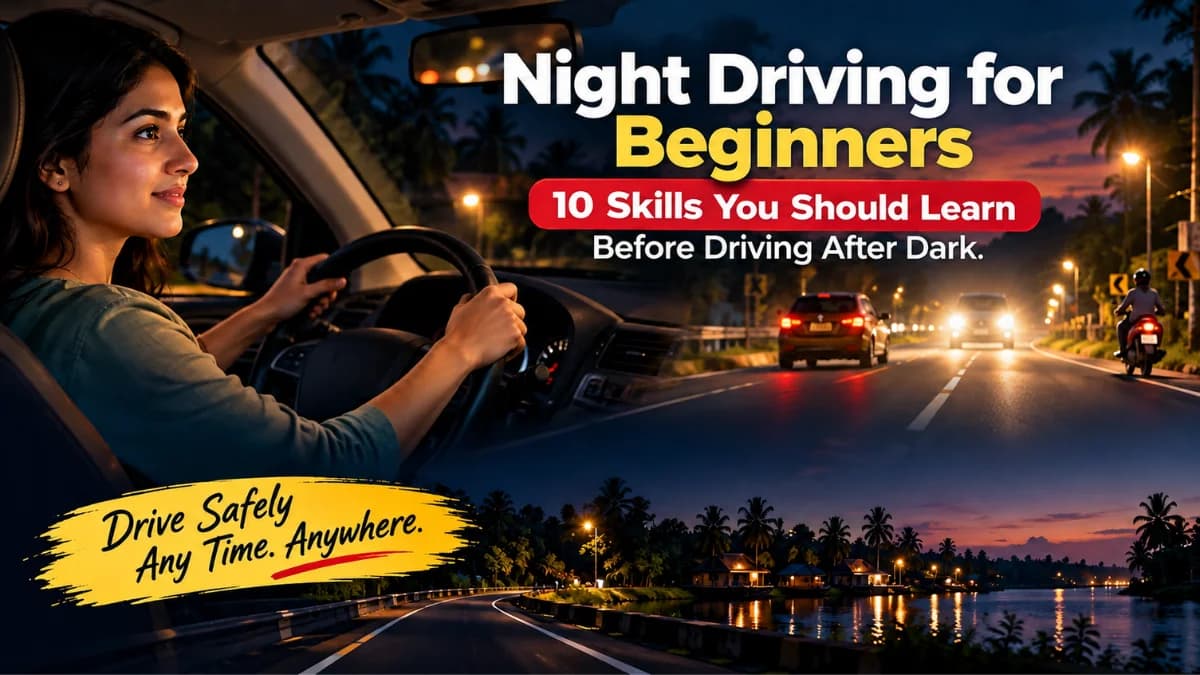
Night Driving for Beginners: 10 Skills You Should Learn Before Driving After Dark
Night driving can feel completely different from daytime driving. Reduced visibility, bright headlights, glare, pedestrians, poorly lit roads and unexpected obstacles can make beginners feel nervous—especially on Kerala roads.For a new driver, simply knowing how to operate the car is not enough. You need to understand how visibility, speed, headlights, mirrors, road positioning and observation change after dark.This guide explains 10 essential night-driving skills every beginner should learn before driving alone at night, along with practical training insights from Veena Driving School, Changanacherry, Kottayam.
Why Does Night Driving Feel Difficult for Beginners?
Have you ever driven comfortably during the day but felt nervous when the sun went down?
You are not alone.
During daylight, drivers have a much wider visual field. At night, darkness limits what you can see beyond the area illuminated by your vehicle's lights. Headlight glare from oncoming vehicles can temporarily affect visibility, while pedestrians, cyclists, parked vehicles and road hazards may be harder to notice.
For beginners, the solution is not to avoid night driving forever. It is to build the right skills gradually.
1. Master Your Headlights
Your headlights are one of your most important tools when driving after dark.
Before starting a night journey, understand your vehicle's headlights, low/dipped beam, high beam, fog lamps where fitted, indicators, tail lights and brake lights.
A common beginner mistake is assuming that more light is always better and keeping the high beam on continuously. That can create glare for other road users.
At Veena Driving School, learners are taught vehicle controls as part of practical driving education. Learning how to use lights and indicators correctly is an important part of becoming a confident driver.
Remember: Learn the lights before you need them.
2. Learn How to Handle Headlight Glare
One of the biggest problems beginners face at night is glare from approaching vehicles.
A bright headlight can make it temporarily difficult to see the road clearly. Instead of staring directly at approaching headlights, maintain proper awareness of your lane and road position while reducing speed when necessary.
Do not respond by switching on your own high beam continuously. The objective is to see without dazzling other drivers.
Imagine driving on a narrow road near Changanacherry at night and an approaching vehicle suddenly appears with bright headlights. Controlled observation helps you maintain your lane position without panic.
3. Reduce Speed When Visibility Is Limited
One of the most important night-driving habits is understanding that your speed should match what you can safely see and react to.
You may be travelling on a familiar road, but darkness can make pedestrians, animals, parked vehicles or road obstacles harder to identify.
Slowing down gives you more time to observe, identify, decide and react.
Don't think, “I know this road, so I can drive at the same speed.” Instead think, “Can I see clearly enough to respond safely?”
4. Improve Your Mirror Awareness
Mirrors become especially important when visibility is limited.
Before driving, adjust your rear-view mirror and side mirrors. Then develop the habit of checking them regularly.
You need to understand what is behind you, whether a vehicle is approaching, whether someone is overtaking and how close the vehicle behind you is.
Mirror awareness should become a habit rather than something you remember only when you need it.
5. Learn Proper Road Positioning
Night driving is not the time to experiment with road positioning.
You need to know where your vehicle is in relation to your lane, the road edge, oncoming traffic, parked vehicles, junctions, pedestrians and two-wheelers.
On Kerala's narrower roads, this becomes particularly important. Good road positioning requires observation and judgement, not simply following a fixed distance.
6. Watch for Pedestrians, Two-Wheelers and Unlit Hazards
A common beginner mistake is to focus only on other cars.
Night traffic can include pedestrians, cyclists, motorcycles, auto-rickshaws, parked vehicles, animals and roadside obstacles. Some may be difficult to see until you are relatively close.
Continuously scan the road rather than looking only at the area immediately in front of your bonnet.
Ask yourself: “What might happen next?” That is anticipation.
7. Become Comfortable With Junctions at Night
Junctions can become more challenging after dark. You may have headlight glare, vehicles approaching from multiple directions, pedestrians crossing, poorly visible road markings and two-wheelers entering from the side.
Slow down before the junction. Check your mirrors. Observe the road. Look in the direction of possible traffic. Use your indicators correctly. Then proceed only when you have assessed the situation.
Learning proper junction technique is much more valuable than simply memorising test manoeuvres.
8. Learn to Drive Through Curves and Narrow Roads
Night driving becomes even more challenging on curves because you cannot always see what is beyond the bend.
Reduce speed before the curve, maintain proper road position, watch for oncoming vehicles, avoid unnecessary overtaking and be prepared for unexpected road users.
Kerala's roads can vary dramatically—from busy urban streets to narrow village roads and hilly routes. A driver who is comfortable only on a familiar straight road may struggle when the environment changes.
At Veena, practical driving is not limited to basic vehicle movement. Learners can develop experience with different road situations as part of their practical training.
9. Learn How to Manage Your Confidence
Overconfidence can be just as problematic as nervousness.
A beginner might think, “I have my licence, so I can drive anywhere.” But getting a licence does not mean every driving situation will immediately feel easy.
If you are uncomfortable, start gradually: familiar, well-lit roads; short evening drives; moderate traffic after dark; longer night journeys; and more challenging roads when you are ready.
The goal isn't to remove fear instantly. The goal is to replace uncertainty with skill and experience.
10. Learn a Proper Pre-Drive Night Check
Before heading out at night, spend a few minutes checking the vehicle.
Check headlights, tail lights, brake lights, indicators, mirrors, windscreen cleanliness, wipers, tyres and brakes.
Dirty glass can make glare and visibility problems worse. Faulty lights can make it harder for you to see and for other road users to identify your vehicle.
A simple pre-drive check can become an important part of safe driving.
Why Should Beginners Practise Night Driving?
Because daytime confidence does not automatically equal nighttime confidence.
During the day, you may be comfortable with steering, gear changes, braking, parking and turning. At night, you must add another layer: visibility management.
You need to interpret headlights, judge distances, recognise hazards, manage glare and maintain proper road positioning.
That is why night driving should be approached as a skill that develops with structured practice.
How Veena Driving School Helps Build Practical Driving Skills?
For learners in Changanacherry and Kottayam, Veena Driving School focuses on developing practical driving abilities rather than treating the licence as the final objective.
25+ Years of Driving Training Experience: Veena brings more than 25 years of experience in driver training.
LMV, HMV and Trailer Training: Veena offers training across multiple vehicle categories, including LMV, HMV and Trailer.
Dedicated Training Ground: Veena has a dedicated training ground at Paippad on NH 183, providing an environment for learners to develop fundamental vehicle-control skills and practise important manoeuvres.
Practical Road Training: Real roads introduce traffic, junctions, pedestrians, two-wheelers, narrow roads, curves and different road conditions. Veena's training approach combines foundational vehicle-control practice with practical road experience.
RTO Test Preparation: The focus is on developing underlying abilities such as vehicle control, observation, road positioning, signalling and judgement, rather than simply memorising one test manoeuvre.
Night Driving Mistakes Beginners Should Avoid
Driving too fast — Reduced visibility requires better judgement of speed.
Using high beam continuously — High beam can dazzle other road users.
Looking directly at oncoming headlights — Maintain awareness of your road position rather than fixating on glare.
Ignoring mirrors — Limited visibility makes mirror awareness even more important.
Assuming familiar roads are always safe — Road conditions and traffic change.
Driving with dirty headlights or windscreen — Reduced visibility can become worse.
Sudden braking or steering — Smooth, controlled inputs are important.
Driving when too tired — Fatigue can affect attention and reaction. If you are too tired to drive safely, don't drive.
Is Night Driving Safe for Beginners?
Night driving can be safe when the driver is appropriately trained, alert, follows traffic regulations, uses the vehicle's lighting correctly and adjusts speed and driving behaviour to visibility and road conditions.
Beginners should not feel pressured to immediately undertake long or difficult night journeys. Build your skills progressively.
Confidence should come from competence—not from taking unnecessary risks.
Frequently Asked Questions About Night Driving
Is night driving harder for beginners?It can be more challenging because darkness reduces visibility and vehicle headlights can create glare. Beginners should develop night-driving skills gradually.
Should I use high beam while driving at night?High beam should not be used inappropriately or for prolonged periods. Follow applicable Kerala traffic regulations.
Should I reduce my speed at night?Choose a safe speed appropriate to visibility, traffic, road conditions and applicable speed limits.
What should I check before night driving?Check headlights, tail lights, indicators, brakes, tyres, mirrors and windscreen, among other relevant vehicle systems.
Can I learn night driving at a driving school?Ask your driving school about its current practical training programme and whether appropriate night-driving practice is available.
How can I become more confident driving at night?Start gradually on familiar roads and build experience with proper guidance. Focus on observation, speed control, road positioning and handling glare.
Conclusion
Learn to See More Than the Road Ahead
Night driving isn't simply daytime driving after sunset.
It requires a different level of observation and awareness.
You need to understand your headlights, manage glare, control your speed, use mirrors effectively, anticipate hazards, position your vehicle correctly and remain calm when visibility is limited.
For beginners, these skills develop through structured training and regular practice.
At Veena Driving School, Changanacherry, the focus goes beyond simply helping learners obtain a licence. With 25+ years of training experience, LMV, HMV and trailer programmes, a dedicated training ground at Paippad on NH 183, practical road training and RTO preparation, Veena helps learners work towards becoming more confident and responsible drivers.
Because the real achievement isn't just saying: “I have a driving licence.”
It is being able to say: “I know how to drive safely—even when the road gets challenging.”
Veena Driving School – Changanacherry, KottayamLearn with experience. Build your skills. Drive with confidence.
Note: Traffic rules, licensing requirements and training procedures can change. Always follow the latest instructions issued by the Kerala Motor Vehicles Department and applicable authorities.